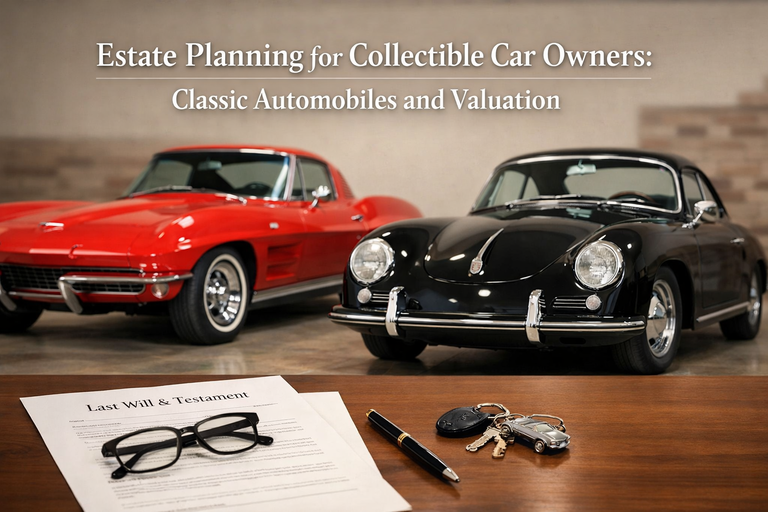
Estate planning for collectible car owners is about far more than assigning a dollar value to a vehicle. For serious collectors, classic automobiles represent history, craftsmanship, personal identity and often significant financial value. Without proper planning, however, collections are frequently undervalued, mishandled, or liquidated poorly after death, destroying both economic and sentimental value.
This article explains how collectors can plan for classic automobiles with precision, protect provenance, and ensure their cars are managed; or sold, the way they intended.
How Are Classic Cars Appraised for a Florida Estate?
This is usually the first question families ask, and it’s worth answering clearly: a classic car isn’t valued the way a regular used car is. Blue Book and typical resale sites don’t apply. For estate and probate purposes, you need a date-of-death valuation from a qualified classic car appraiser, someone with real expertise in the specific make, model, and era, not a general auto appraiser.
A proper appraisal for estate settlement should include:
- Fair market value as of the date of death, which sets the tax basis
- Documentation of condition, originality, and any restoration work
- Photos and, ideally, video
- A written report the personal representative can submit as part of the estate inventory
This appraisal matters for three separate reasons: it sets the estate’s reported value, it establishes the step-up in basis heirs will use if they later sell, and it’s what insurance and any eventual buyer will rely on. Getting it wrong in any direction, too high or too low, creates problems down the line.
When a Son or Daughter Inherits a Classic Car Collection
A common scenario: an adult child inherits a parent’s collection, sometimes a single car, sometimes a dozen, and has no real background in the classic car world. A few things matter immediately:
- The appraisal above should happen as close to the date of death as practical, since values in this market can shift and a stale number causes problems later.
- Ownership and title need to be sorted out before anything else happens, especially if multiple cars were titled differently.
- Insurance can lapse quickly if no one is actively managing the policy, and a gap in coverage on a high-value vehicle is a real risk.
- There’s no obligation to keep, sell, or decide anything immediately. Rushing a decision under emotional pressure is exactly how collections get sold below value.
Legal Classic Car Ownership: Titling and Registration Issues
Many estate problems arise from how cars are titled.
Common ownership structures include:
- Personal ownership
- Joint ownership
- LLC ownership
- Trust ownership
Mistakes to avoid:
- Titles not matching estate documents
- Joint ownership that defeats intended distribution
- Cars titled personally but insured through entities
Titles control transfer. If titling and estate planning are misaligned, executors may face delays, re-titling problems, or forced probate sales.
Club Memberships, Provenance, and Intangible Value
Serious collectors know that provenance matters.
Memberships in marque-specific clubs, concours participation, racing history, or celebrity ownership can materially affect value. These details are often lost after death unless documented.
Estate plans should:
- Identify club memberships
- Document transferable benefits
- Preserve records tied to vehicle history
A Ferrari with incomplete provenance is worth less, even if mechanically perfect.
Climate-Controlled Storage and Ongoing Care
Classic cars degrade quickly if neglected.
After death, problems arise when:
- Storage fees lapse
- Climate control fails
- Battery maintenance stops
- Fluids deteriorate
Estate planning should address:
- Funding for ongoing storage
- Authority for executors to maintain vehicles
- Instructions for trusted specialists
Without continuity, value can erode in months, not years.
Selling vs. Keeping the Collection
One of the most important decisions is whether cars should be:
- Retained by heirs
- Sold immediately
- Sold selectively over time
- Donated or placed in museums
Each option has consequences:
- Forced sales often produce discounts
- Inexperienced heirs may mishandle transactions
- Auction timing matters significantly
Florida collectors often underestimate how long it takes to sell high-end vehicles properly. A rushed sale is rarely a good sale.
Executor Knowledge Requirements
Naming the wrong executor is a common and costly error.
An executor unfamiliar with:
- Classic car markets
- Auction houses
- Restoration value
- Collector networks
is likely to undersell or mishandle assets.
Best practices include:
- Naming a co-executor with automotive expertise
- Providing authority to hire specialists
- Documenting preferred brokers or auction houses
Competence matters more than convenience.
Insurance Policy Transitions
Collector car insurance is specialized.
Issues arise when:
- Policies lapse at death
- Coverage does not extend to estates
- Agreed value policies are not updated
Estate plans should ensure:
- Continuous coverage
- Authority to renew policies
- Alignment between appraisals and insured values
A single uncovered loss can erase decades of value.
Should a Classic Car Collection Go Into a Trust?
Often, yes. Titling a valuable collection in a revocable living trust keeps it out of Florida probate, which matters for two reasons specific to cars: probate is public record, and a public probate filing can attract unwanted attention to a high-value, movable asset. A trust also allows for continuity, your successor trustee can maintain insurance, storage, and upkeep immediately after your death without waiting on court appointment, which matters far more for a depreciating-if-neglected asset than it does for most other property.
Passion Asset vs. Financial Asset
Classic cars occupy a unique space between passion and investment.
Questions collectors should answer explicitly:
- Is financial return the priority?
- Is preservation more important than sale price?
- Should certain cars stay in the family regardless of value?
Heirs should not be left guessing. Ambiguity leads to conflict, or regret.
Florida-Specific Considerations
Florida collectors benefit from:
- No state estate tax
- Favorable climate for year-round ownership
- Strong collector communities
But Florida probate can still be slow and public, both problematic for high-value movable assets like automobiles. Trust-based planning often provides better privacy and continuity.
Common Collector Scenario
A collector dies owning multiple classic cars, each titled personally. The executor lacks market knowledge, storage lapses, and cars are sold quickly below market value to “simplify” the estate.
Proper planning would have preserved both value and legacy.
Actionable Steps for Collectible Car Owners
- Obtain professional appraisals regularly
- Align titles with estate planning documents
- Document provenance and club affiliations
- Fund post-death storage and maintenance
- Name knowledgeable executors or advisors
Frequently Asked Questions
Do classic cars receive a step-up in basis at death?
Yes, generally to fair market value, but proper appraisal is critical.
Should I put my cars in a trust?
Often yes, especially for privacy and smoother transfer.
Can heirs keep cars insured after death?
Yes, but authority and policy coordination matter.
Are joint titles a good solution?
Often no, they can defeat intended distributions.
How is a classic car appraised for a Florida estate?
Through a date-of-death valuation from a qualified classic car appraiser, not a standard auto appraisal, documenting condition, originality, and market value as of the date of death.
What happens if my adult child inherits my classic car collection with no experience in the hobby?
They should get a professional appraisal early, confirm insurance stays active, and avoid a rushed sale. Naming an executor or advisor with collector-market knowledge in advance avoids this problem entirely.
Get Help Protecting a Classic Car Collection
A classic car collection deserves an estate plan that protects both its value and its story. Attorney Yanitza Schoonover can help you structure ownership, coordinate with appraisers, and decide whether a trust makes sense for your collection. Call (305) 299-7496 or schedule a free consultation.