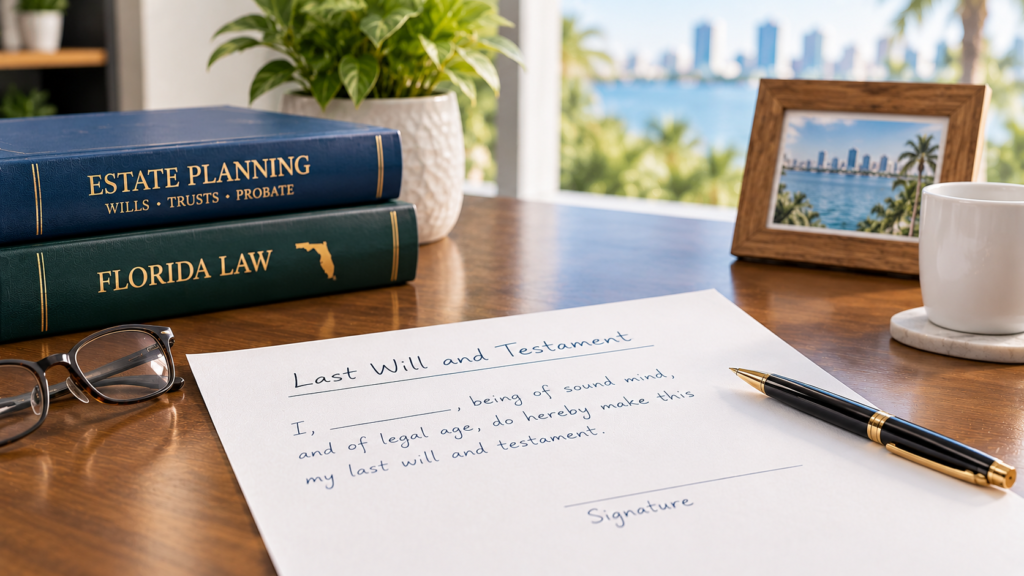
Maybe you found a note in a parent’s desk that says “I leave the house to my daughter,” signed and dated in their own handwriting. Or maybe you are thinking about writing your own will on a sheet of paper tonight to save time and money. Either way, the question is the same: will a handwritten will actually hold up in Florida?
The short answer surprises many people. Florida does not care whether a will is handwritten or typed. It cares about how the will was signed and witnessed. A handwritten will that follows Florida’s signing rules can be valid. A handwritten will signed alone at the kitchen table, with no witnesses, is not. This guide explains what the law says, how holographic wills are treated, when a notary is needed, and how to make sure your wishes are actually carried out.
Quick answer: Florida does not recognize holographic wills, meaning wills that are handwritten and signed by the person without witnesses. A handwritten last will and testament is valid in Florida only if it is signed at the end by the person making it, in front of two witnesses who also sign in front of that person and each other. A notary is not required for the will to be valid, but adding a notarized self-proving affidavit makes the will much easier to use in probate.
What Is a Holographic Will?
A holographic will, sometimes called a holographic testament, is a will written entirely or mostly in the handwriting of the person making it and signed by that person, usually without any witnesses. The word “holographic” simply means “written wholly by hand.”
Roughly half of U.S. states, including California and Texas, accept holographic wills in some form. Florida is not one of them. Section 732.502 of the Florida Statutes requires every will to be witnessed, and it expressly says that a holographic will is not valid in Florida even if it was valid in the state where it was written. So if you moved to Florida from a state that accepts holographic wills and you still have one in a drawer, it will not work here.
Can a Handwritten Will Be Legal in Florida?
Yes, a handwritten will can be legal in Florida, but only if it is signed the same way a typed will must be signed. Florida law focuses on the signing ceremony, not on whether the words were written with a pen or a printer. A handwritten will is valid if it meets every one of these requirements:
- It is in writing. Handwriting counts. Video or audio recordings do not.
- The person making it is at least 18 (or an emancipated minor) and of sound mind.
- The person signs at the end of the will. Anything written below the signature may be ignored.
- Two witnesses are present when the person signs, or when the person acknowledges a signature already made.
- Both witnesses sign in the presence of the person making the will and in the presence of each other.
If any one of these steps is missing, the will fails, and the court treats the person as if they had no will at all. That is why most families choose to work with a Florida wills attorney who supervises the signing so every requirement is met. A full walkthrough of the process is also available in the guide on how to make a legal will in Florida.
Handwritten Will vs. Holographic Will in Florida
| Type of Will | How It Is Signed | Valid in Florida? |
|---|---|---|
| Holographic will | Handwritten and signed by the person alone, no witnesses | No |
| Handwritten will with two witnesses | Handwritten, signed by the person in front of two witnesses who also sign | Yes |
| Handwritten will with witnesses and self-proving affidavit | Same as above, plus a notarized self-proving affidavit | Yes, and easiest to admit to probate |
| Typed will signed alone | Printed and signed with no witnesses | No |
| Oral (nuncupative) will | Spoken, not written | No |
| Electronic will | Signed electronically under Florida’s electronic will rules | Yes, if strict statutory steps are followed |
Does a Will Need to Be Notarized in Florida?
No. Florida does not require a notary for a will to be valid. Two witnesses are what make a will legal. However, a notary still plays an important role, because a notary is needed to make a will “self-proving.”
What Is a Self-Proving Will?
A self-proving will is a will that includes a self-proving affidavit, a short sworn statement signed by the person making the will and both witnesses in front of a notary. Under Section 732.503 of the Florida Statutes, the affidavit confirms that the will was signed properly, that the person appeared to be of sound mind, and that no one forced them to sign.
Here is why that matters. When a will without a self-proving affidavit is filed in probate, the court usually needs a sworn statement from one of the original witnesses confirming the signing. If the witnesses have moved away, cannot be found, or have died, your family may face delays and extra legal costs to prove the will is real. A self-proving will skips that step entirely.
Does a Handwritten Will Need to Be Notarized?
A handwritten will follows the same rules as any other will. It does not need to be notarized to be valid, but it must have two witnesses. Adding a self-proving affidavit with a notary is strongly recommended, because handwritten documents are more likely to be questioned. Messy writing, crossed out words, and missing pages all give a relative a reason to challenge the will.
Can I Write My Own Will in Florida?
Yes. Florida law does not require a lawyer to prepare a will. You can write your own will by hand or on a computer, and it can be valid if you sign it correctly with two witnesses. But being allowed to do something and being safe doing it are two different things.
Common Problems With Do It Yourself and Handwritten Wills
- Missing or improper witnesses. The most common reason homemade wills fail. Witnesses must be present at the same time and sign in front of each other.
- Handwritten changes after signing. Crossing out a name or adding a line after the will is signed generally has no legal effect in Florida unless the will or a codicil is signed again with full witness formalities. The changes can also create confusion about what you meant.
- Unclear language. Phrases like “my things go to the kids” leave room for argument about who counts as your kids and what counts as your things.
- Florida homestead rules. If you are survived by a spouse or minor child, Florida limits who can inherit your home, no matter what your will says. Homemade wills often try to leave the house in a way the law will not allow.
- No personal representative who qualifies. Florida only lets someone who lives out of state serve as personal representative if they are a close relative. Naming the wrong person can force the court to appoint someone else.
- Assets that a will cannot control. Life insurance, retirement accounts, and payable on death accounts go to the named beneficiary, not to the people in your will.
Even a perfect will still goes through probate. If you would prefer to keep your family out of court, a revocable living trust or a Lady Bird deed for your Florida home may be a better fit. The pros and cons of each approach are compared in the article on will vs. trust in Florida.
How to Write a Handwritten Will That Is Valid in Florida
If you decide to write a handwritten last will and testament, these steps will give it the best chance of holding up:
- Write clearly in ink on clean paper. Avoid crossing out or writing in the margins.
- State that it is your will and that it revokes all earlier wills.
- Name a personal representative and a backup.
- Name who receives what, using full legal names, and say who receives anything left over.
- Name a guardian for minor children if you have them.
- Sign at the very end in front of two adult witnesses who are present together.
- Have both witnesses sign in front of you and each other.
- Add a self-proving affidavit signed by you and both witnesses before a notary.
- Store the original safely and tell your personal representative where it is. Florida requires whoever has the original will to deposit it with the clerk of court within 10 days of learning of the death.
A will is only one part of a complete plan. It does not help if you become incapacitated, so most families also sign a durable power of attorney, a healthcare surrogate designation, and a living will at the same time.
What Happens If a Handwritten Will Is Not Valid in Florida?
If a handwritten will was not properly witnessed, the probate court will refuse to admit it. Your estate then passes under Florida’s intestacy law, which decides who inherits based on a fixed family order rather than your wishes. An unmarried partner receives nothing. Friends and charities receive nothing. A spouse may have to share with children from an earlier relationship.
Your family will still have to open a Florida probate case, and depending on the size of the estate, that may be a summary administration for smaller estates or a full formal administration. The steps families face in the meantime are explained in what happens after someone dies in Florida.
If you have minor children and no valid will names a guardian, a judge decides who raises them. Families in that situation often need help from a Florida guardianship attorney, which is slower and more expensive than naming a guardian in a properly signed will.
Can I Make a Will Without a Lawyer?
You can, but the savings are often smaller than people expect, and the risk falls on your family later. A mistake in a homemade will is usually discovered only after death, when it can no longer be fixed. An estate planning attorney makes sure your will is signed correctly, includes a self-proving affidavit, works with Florida homestead rules, and fits together with your beneficiary designations and any trust.
If you already have a will, handwritten or typed, it is worth having it reviewed after any major life change. The guide on how to update or change your will in Florida explains when a codicil is enough and when a new will is the better choice.
Frequently Asked Questions
Is a handwritten will valid in Florida?
Does Florida recognize holographic wills?
Does a will need to be notarized in Florida?
Does a handwritten will need to be notarized?
What is a self-proving affidavit for a will?
Can I write my own will in Florida?
Can a last will and testament be handwritten?
Can a beneficiary be a witness to a will in Florida?
Can I make handwritten changes to my will?
What happens if a handwritten will is not valid?
Work With a Florida Estate Planning Attorney
A will only protects your family if it is signed the way Florida law requires. If you have found a handwritten will after a loved one’s death and are not sure it will be accepted, our probate attorney services can help you understand your options, whether the estate qualifies for summary administration or needs a full formal administration.
If you are planning ahead, Attorney Yanitza Schoonover prepares wills with a self-proving affidavit in every case, and she can pair your will with a revocable living trust or a Lady Bird deed so your home and savings avoid probate altogether. She also plans ahead for Medicaid estate recovery risks, so the plan you sign protects the people you love. You can contact the firm to get started.
Call (305) 299-7496 or email info@estateplanningattorney.us to schedule a free initial consultation. Phone and Zoom appointments are available Monday through Sunday, 8:00 AM to 9:00 PM.
The Schoonover Law Firm, P.A. | 6303 Waterford District Drive, Suite 400, Miami, FL 33126 | Florida Bar #124081