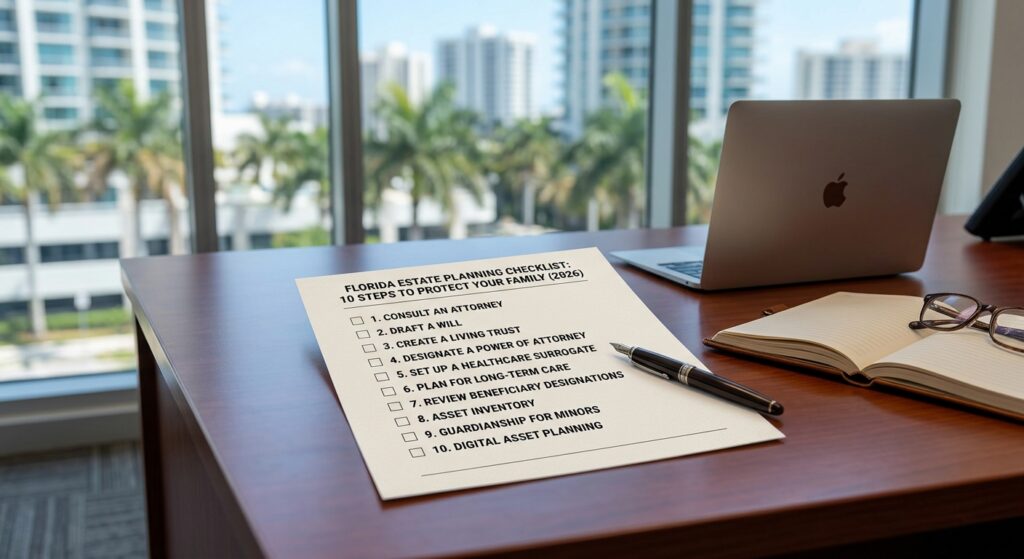
A complete Florida estate plan comes down to a few key legal documents and a handful of decisions that only you can make. This Florida estate planning checklist walks you through 10 steps, from listing your assets to signing a will, a trust, a durable power of attorney and advance directives that meet Florida law. Work through it before you meet with a Florida estate planning attorney and you will arrive prepared, which saves both time and money.
Why Every Florida Adult Needs an Estate Plan
Florida estate planning laws decide what happens to your property and your medical care if you die or become unable to make decisions. If you have no plan, the state makes those choices for you.
Under Florida inheritance laws, a person who dies without a will has their estate divided under the intestacy rules in Chapter 732 of the Florida Statutes. Your surviving spouse receives everything only if all of your children are also your spouse’s children and your spouse has no other descendants. In every other case, the estate is split, and the people you would have chosen may receive nothing.
Incapacity is just as important. If you become seriously ill or injured without a durable power of attorney, your family may need to ask a court to appoint a guardian. That process is public, slow and expensive.
An estate plan solves both problems. It names the people you trust, keeps your family out of unnecessary court proceedings and makes your wishes legally binding.
The Florida Estate Planning Checklist: 10 Steps
Step 1: Take Inventory of Your Assets and Debts
Start with a complete list of what you own and what you owe. This list shapes every other decision in your plan.
Include:
- Your home and any other real estate, including property in other states
- Bank, savings and brokerage accounts
- Retirement accounts such as IRAs and 401(k) plans
- Life insurance policies
- Business interests
- Vehicles, valuables and digital assets
- Mortgages, loans and other debts
Note how each asset is titled and whether it already has a named beneficiary. Accounts with a beneficiary pass outside your will, so they need separate attention.
Step 2: Decide Who Will Inherit and Who Will Be in Charge
Next, decide who receives your property and who manages your affairs. You will need to choose:
- Beneficiaries: the people or charities who will receive your assets
- Personal representative: the person who settles your estate through probate. Florida limits who can serve. A nonresident must generally be a close relative, such as a child, parent, sibling or spouse.
- Successor trustee: the person who manages your trust if you become incapacitated or pass away
- Guardian for minor children: the person who would raise your children if both parents are gone
- Financial agent and healthcare surrogate: the people who make decisions for you during your lifetime if you cannot
Always name at least one backup for each role.
Step 3: Create a Last Will and Testament That Meets Florida Requirements
A last will and testament in Florida directs who receives your probate assets, names your personal representative and nominates a guardian for your minor children. Even if you create a trust, you still need a will.
Florida will requirements are strict:
- You must be at least 18 years old, or an emancipated minor, and of sound mind.
- The will must be in writing and signed by you at the end.
- Two witnesses must sign in your presence and in the presence of each other.
Notarization is not required to make a Florida will valid. However, most attorneys add a self proving affidavit, signed before a notary. It lets the court accept the will without tracking down your witnesses after your death.
Handwritten wills are not valid in Florida unless they are signed with two witnesses like any other will. Florida does allow electronic wills, but they must follow specific statutory procedures. You can learn more in our guide to making a legal will in Florida, or work directly with an experienced wills attorney to make sure your will holds up.
Keep in mind that a will does not avoid probate. It simply tells the probate court what you want.
Step 4: Decide Whether You Need a Revocable Living Trust
A revocable living trust in Florida holds your assets during your lifetime and transfers them to your beneficiaries after your death, without probate. You keep full control while you are alive and can change or cancel the trust at any time.
A trust is often the right choice if you:
- Want to keep your estate out of probate court
- Own real estate in more than one state
- Want your financial affairs kept private
- Have minor children or beneficiaries who should receive assets over time
- Want a seamless plan for managing your assets if you become incapacitated
Florida requires the testamentary parts of a revocable trust to be signed with the same formalities as a will, which means two witnesses. Trusts are usually notarized as well. A trust is normally paired with a pour over will, which catches any assets left outside the trust. A revocable living trust attorney can help you decide whether a trust fits your family and your assets.
Step 5: Fund Your Trust
Signing a trust is only half the job. A trust controls only the assets that are titled in its name. An unfunded trust does not avoid probate.
Funding usually means:
- Recording a new deed that transfers your home into the trust
- Retitling bank and brokerage accounts in the name of the trust
- Assigning business interests and valuable personal property
Retirement accounts are handled differently. They are not retitled; instead, you update their beneficiary designations. Our step by step guide explains how to fund your living trust correctly.
Step 6: Sign a Florida Durable Power of Attorney
A Florida durable power of attorney names an agent to handle your finances if you cannot. It is one of the most important documents in any plan, because it lets your family avoid a court guardianship.
The Florida power of attorney requirements are found in Chapter 709 of the Florida Statutes:
- You must sign the document in front of two witnesses and a notary.
- It must include language stating that it stays in effect if you become incapacitated.
- Your agent must be at least 18 years old, or a financial institution with trust powers.
- Florida does not allow new “springing” powers of attorney that only take effect upon incapacity. A power of attorney signed after October 1, 2011 is effective immediately.
Certain sensitive powers, such as creating or changing a trust, making gifts or changing beneficiary designations, only apply if you separately sign or initial next to each one. Generic online forms often miss this. A properly drafted durable power of attorney gives your agent the authority they actually need.
Step 7: Complete Your Florida Advance Directives
Florida advance directives put your medical wishes in writing and name the person who will speak for you. Most plans include two documents:
- Designation of Healthcare Surrogate: names the person who makes medical decisions for you when you cannot
- Living Will: states your wishes about life prolonging procedures if you have a terminal condition, an end stage condition or a persistent vegetative state
Each document must be signed in front of two adult witnesses, and at least one witness cannot be your spouse or a blood relative. Your chosen surrogate cannot act as a witness. Notarization is not required. Including HIPAA authorization language allows your surrogate to access your medical records.
Step 8: Plan for Your Home Under Florida Homestead Rules
Your home often needs special planning in Florida. Under the Florida Constitution, if you are survived by a spouse or a minor child, you cannot freely leave your homestead to anyone you choose. A will that ignores these rules can be overridden.
Two common tools help you pass your home without probate:
- Lady Bird Deed: an enhanced life estate deed that keeps you in full control of your home during your lifetime and transfers it automatically at death. It also preserves your homestead tax exemption.
- Deed to your revocable trust: places your home under your trust’s instructions
A Lady Bird Deed is often the simplest option for homeowners who do not need a full trust. Either way, the transfer must respect Florida’s homestead restrictions, and your spouse may need to sign the deed.
Step 9: Review Every Beneficiary Designation
Life insurance, retirement accounts, annuities and payable on death bank accounts pass directly to the named beneficiary. These designations override your will and your trust.
Pull every account statement and confirm:
- The primary and backup beneficiaries are correct
- No former spouse is still listed
- Minor children are not named directly, since a minor cannot manage a large inheritance
Florida law automatically revokes some designations in favor of a former spouse after divorce, but not all of them. Learn more about how beneficiary designations work before you make changes.
Step 10: Store Your Documents Safely and Review Your Plan Regularly
Your documents only work if the right people can find them. Keep originals in a secure, fireproof location and tell your personal representative, trustee and agents where they are.
Be careful with safe deposit boxes. Access after death can be restricted. In Florida, anyone holding an original will must deposit it with the clerk of court within 10 days after learning of the person’s death.
Review your plan every three to five years, and update it right away after:
- Marriage or divorce
- The birth or adoption of a child
- The death of a beneficiary, agent or personal representative
- A major change in your assets
- A move to Florida from another state
If you recently moved, have your out of state documents reviewed. They may be valid, but Florida banks, courts and title companies can still raise problems with documents not drafted under Florida law.
Florida Estate Planning Documents at a Glance
| Document | What It Does | Florida Signing Requirements |
|---|---|---|
| Last will and testament | Directs probate assets, names a personal representative and a guardian for minor children | Two witnesses; notary needed only for a self proving affidavit |
| Revocable living trust | Transfers trust assets without probate and covers incapacity | Two witnesses for testamentary provisions; usually notarized |
| Durable power of attorney | Names an agent for financial and legal decisions | Two witnesses and a notary |
| Designation of healthcare surrogate | Names a medical decision maker | Two adult witnesses, one not a spouse or blood relative |
| Living will | States end of life treatment wishes | Two adult witnesses, one not a spouse or blood relative |
| Lady Bird Deed | Transfers your home at death without probate | Two witnesses and a notary; recorded with the county clerk |
Common Florida Estate Planning Mistakes to Avoid
- Using generic online forms. Many do not meet Florida witnessing rules or omit the separate initials required for power of attorney superpowers.
- Creating a trust and never funding it. Assets left outside the trust still go through probate.
- Forgetting beneficiary designations. An outdated form can send money to an ex spouse.
- Ignoring homestead restrictions. A will that conflicts with Florida’s homestead rules will not control your home.
- Never updating the plan. A plan written 15 years ago may name people who are no longer the right choice.
Frequently Asked Questions
What documents do I need for estate planning in Florida?
Most Florida estate plans include a last will and testament, a durable power of attorney, a designation of healthcare surrogate and a living will. Many families also add a revocable living trust or a Lady Bird Deed to avoid probate.
Does a will need to be notarized in Florida?
No. A Florida will is valid if it is signed by you and two witnesses. Adding a notarized self proving affidavit is strongly recommended, because it speeds up probate.
Does Florida have an inheritance tax?
No. Florida has no state estate tax and no inheritance tax. Only very large estates are subject to the federal estate tax, which in 2026 exempts up to $15 million per person.
What happens if I die without a will in Florida?
Florida inheritance laws decide who receives your property. Your estate goes to your spouse, children or other relatives in the order set by statute, regardless of what you would have wanted, and a court appoints the person who settles your estate.
How often should I update my estate plan?
Review it every three to five years, and update it immediately after a major life event such as marriage, divorce, a new child or a move to Florida.
Start Your Florida Estate Plan Today
Checking off this list is the first step. The next step is turning your decisions into legally valid documents that hold up when your family needs them. Attorney Yanitza Schoonover personally drafts every plan, provides a flat fee quote in writing before any work begins and offers service in English and Spanish.
Call (305) 299-7496 or schedule a free consultation to start building your Florida estate plan.