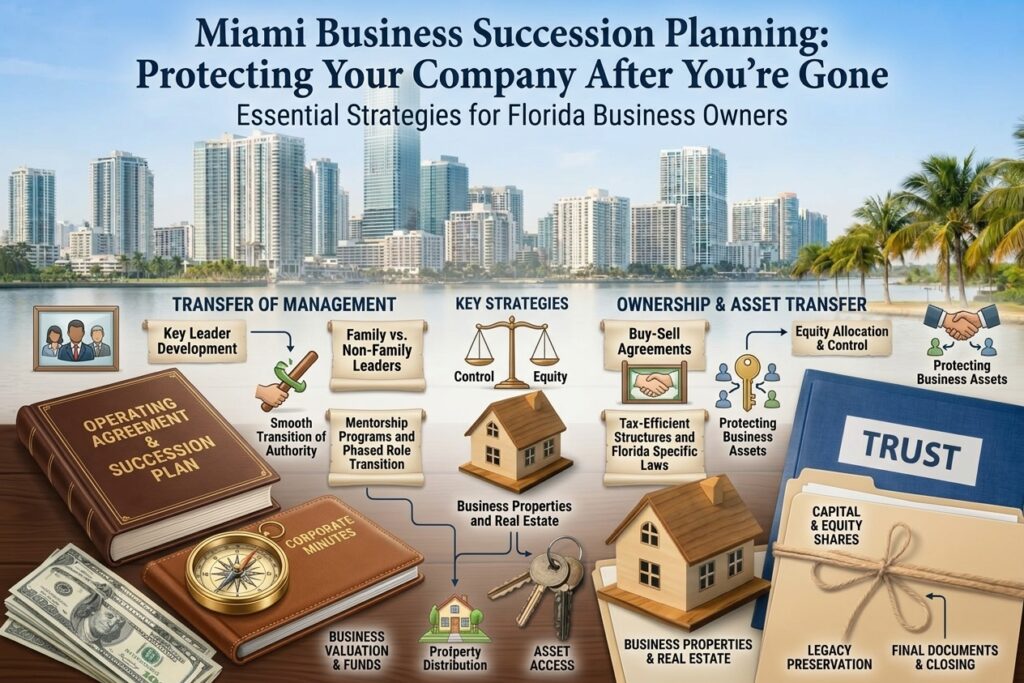
You have spent years building your business. You know every client, every supplier, and every bank login. But if you died or became seriously ill tomorrow, would anyone else be able to keep the doors open? Would your family inherit a working company, or a court case and a business losing value by the week?
Business succession planning answers those questions before they become emergencies. This guide explains, in plain language, what business succession planning is, what happens to a Florida LLC or corporation when the owner dies, the key documents every business owner needs, how family business succession planning works, and how to bring your business and estate planning together into one plan.
Quick answer: Business succession planning in Florida is the process of deciding who will own and run your company if you retire, become incapacitated, or die, and putting the legal documents in place to make that happen smoothly. A strong plan usually includes an updated operating agreement or bylaws, a buy-sell agreement funded with life insurance, a revocable living trust that holds your ownership interest, a durable power of attorney with business powers, and a written plan for who takes over management. Without it, your ownership may get stuck in probate and, for a single-member LLC, the company can even dissolve.
What Is Business Succession Planning?
Business succession planning is a written plan for transferring both the ownership and the management of your business. Those are two different things, and good plans treat them separately:
- Ownership succession decides who receives the value of the business: your spouse, your children, your partners, or a buyer.
- Management succession decides who actually runs the business day-to-day, which may be a different person entirely.
A complete plan covers three possible events: your planned retirement or sale, your unexpected incapacity, and your death. Many business transition plans only address retirement, which leaves the company exposed if something happens sooner.
Why Business Owners Need an Estate Plan
For most business owners, the company is their largest asset. Estate planning for business owners means making sure that asset is protected the same way you protect your home and savings. Business and estate planning should be done together, because decisions in one directly affect the other. A will that leaves “everything to my three children equally” can create a nightmare if only one child works in the business. A trust that was never funded with your LLC interest will not keep that interest out of probate.
Working with a Florida estate planning attorney who looks at your business documents and your personal estate plan side by side is the simplest way to avoid conflicts between them.
What Happens to an LLC When the Owner Dies in Florida?
This is one of the most common questions small business owners ask, and the answer depends on how the LLC is set up.
Single-Member LLC
If you are the only member and your LLC interest is in your name alone, that interest becomes part of your probate estate. Your personal representative must be appointed by the court before anyone has clear authority over the company. Meanwhile, bank accounts may be frozen, contracts may go unsigned, and employees may not get paid.
Florida law adds another risk. If an LLC has no members for 90 consecutive days, it is generally dissolved unless, within that time, the deceased member’s legal representative or successor agrees to continue the company and is admitted as a member. Probate often takes longer than 90 days to get started, so without planning the company can dissolve by default.
Multi-Member LLC
In an LLC with partners, your heirs usually inherit only the economic rights to your share, meaning distributions, but not the right to vote or manage, unless the operating agreement says otherwise. That can leave your family with little say and your partners with an unwanted new co-owner. A buy-sell agreement and a clear operating agreement prevent both problems.
How to Protect Your LLC
- Assign your LLC interest to your revocable living trust so it passes without probate and your successor trustee can step in immediately.
- Update your operating agreement to name a successor manager and explain what happens to your interest at death or incapacity.
- Sign a buy-sell agreement with your partners.
- Add business powers to your durable power of attorney so someone can run the company if you are incapacitated.
What Happens to a Corporation When the Owner Dies?
Shares of a corporation are personal property. If they are in your name alone, they pass through probate under your will, or under Florida’s intestacy law if you have no will. The board continues to exist, but if you were the sole director and officer, no one may have authority to act until the estate is opened. Holding your shares in a revocable trust, and naming successor directors and officers in advance, avoids that gap. If your company is an S corporation, the trust must be drafted carefully so it qualifies to hold S corporation stock after your death, or the company can lose its S status.
Key Parts of a Business Succession Plan
1. Choose Your Successor Owners and Managers
Decide who should own the business and who should run it. These may be family members, key employees, partners, or an outside buyer. Be honest about who has the skills and the interest.
2. Update Your Operating Agreement or Bylaws
Your company’s governing documents should say who can manage the business if you cannot, how ownership can be transferred, and whether heirs become full members or only receive distributions.
3. Sign a Buy-Sell Agreement
A buy-sell agreement is a contract among owners that sets out what happens to an owner’s share if they die, become disabled, retire, divorce, or want to leave. It answers who can buy the share, how the price is set, and how the purchase is paid for. There are two common structures:
| Structure | How It Works | Things to Consider |
|---|---|---|
| Cross-purchase | The remaining owners buy the departing owner’s share directly | Each owner typically holds life insurance on the others; can become complicated with many owners |
| Entity redemption | The company itself buys back the share | Simpler to administer, but the U.S. Supreme Court ruled in 2024 that company-owned life insurance used for a redemption can increase the company’s value for estate tax purposes, so the structure should be reviewed |
4. Fund the Plan With Life Insurance
A buy-sell agreement only works if someone has the money to buy the share. Life insurance is the most common way to fund it. Key person insurance can also give the company cash to hire or train a replacement if an essential owner or employee dies.
5. Set a Valuation Method
Agree in advance on how the business will be valued: a fixed price updated each year, a formula, or an independent appraisal. Disputes over value are one of the most common reasons business transitions end in litigation.
6. Hold Your Ownership in a Revocable Living Trust
A revocable living trust can hold your LLC interest or corporate shares so they pass to your chosen successors without probate. The trust only works for assets you actually transfer into it, which is explained in how to fund a revocable living trust in Florida.
7. Plan for Incapacity, Not Just Death
A business can fail faster from an owner’s sudden incapacity than from their death. A durable power of attorney should specifically authorize your agent to run the business, sign contracts, and manage business accounts. Your successor trustee can also manage business interests held in your trust. The full picture is covered in incapacity planning in Florida.
8. Write Down the Practical Details
Keep a confidential list of key clients, suppliers, passwords, bank accounts, insurance policies, and professional advisors, and tell your successor where to find it.
Using a Business Succession Trust
A business succession trust is a trust designed to hold and manage a business interest after the owner’s death. It can keep the business running under a trustee who understands it while distributing profits to family members who do not work in the company. It can also release ownership to the next generation in stages, or hold the business until it can be sold for full value instead of in a rush.
Choosing the right trustee is critical, especially when the trustee must oversee an operating company. The guide on how to choose a successor trustee in Florida explains what to look for. For larger estates, certain irrevocable trusts can also move future growth out of your taxable estate, as compared in revocable vs. irrevocable trusts in Florida.
Family Business Succession Planning
Family business succession planning brings its own challenges, because business decisions and family relationships overlap.
Children Who Work in the Business and Children Who Do Not
Leaving the business equally to all children often leads to conflict between the child running it and the siblings who want distributions. Common solutions include leaving the business to the active child and other assets or life insurance to the others, or giving active children voting ownership and inactive children nonvoting ownership.
Second Marriages and Blended Families
A surviving spouse in Florida can claim an elective share of 30% of the elective estate, which can include business interests held in a revocable trust. Without a prenuptial or postnuptial agreement, that claim can disrupt a plan to leave the business to children from a first marriage. The rules are explained in can you disinherit a spouse or child in Florida and estate planning for blended families in Florida.
Talk About the Plan
The most successful family business transitions are discussed openly. Successors should be trained, given responsibility gradually, and introduced to key clients and lenders long before they need to take over.
Estate Tax and Business Transition Planning
Florida has no state estate tax, and the 2026 federal estate tax exemption is $15 million per person. Most small business owners will not owe federal estate tax, but owners of larger or fast-growing companies should plan ahead. Tools may include lifetime gifts of nonvoting ownership, valuation discounts for minority interests, certain irrevocable trusts, and, if tax is owed, federal rules that may allow estate tax on a closely-held business to be paid over time. These strategies should be coordinated with your CPA.
Business Succession Planning Checklist
| Step | Why It Matters |
|---|---|
| Name successor owners and managers | Prevents confusion and power struggles |
| Update operating agreement or bylaws | Gives someone legal authority to act immediately |
| Sign a buy-sell agreement | Sets who can buy your share and at what price |
| Fund it with life insurance | Provides the cash to complete the buyout |
| Transfer your interest to a revocable trust | Keeps the business out of probate |
| Add business powers to your power of attorney | Keeps the company running if you are incapacitated |
| Coordinate with your will and estate plan | Avoids conflicting instructions to your family |
| Review with your CPA | Addresses income and estate tax issues |
| Review every 3 to 5 years | Keeps the plan current as the business grows |
Common Mistakes in Succession Planning for Small Business Owners
- Assuming a will is enough. A will sends your business through probate. The guide on does a will avoid probate in Florida explains why.
- Using an online operating agreement that says nothing about death or incapacity.
- Never funding the buy-sell agreement, leaving partners without money to buy the share.
- Forgetting incapacity, so no one can sign checks while you are in the hospital.
- Leaving the business in personal name instead of a trust.
- Not telling anyone the plan, so successors are unprepared.
Frequently Asked Questions
What is business succession planning?
What happens to an LLC when the owner dies in Florida?
Can I put my LLC in a living trust in Florida?
What is a buy-sell agreement?
How do I plan for succession in a family business?
What is a business succession trust?
Do I need a business succession planning attorney?
What happens to my business if I become incapacitated?
Will my business owe estate tax when I die?
How often should I update my business succession plan?
Work With a Florida Estate Planning Attorney
Your business deserves the same protection as your home and your family. If a business owner in your family has already passed and their company interest is stuck in their name, our probate services can help the personal representative act quickly through formal administration, and the comparison of probate vs. trust administration shows how much simpler a trust makes the process.
Attorney Yanitza Schoonover helps Florida business owners coordinate their revocable trusts, wills, and powers of attorney with their company documents, so the business keeps running and the family stays protected, including from risks such as Medicaid estate recovery in later years. You can contact the firm to review your business and estate plan together.
Call (305) 299-7496 or email info@estateplanningattorney.us to schedule a free initial consultation. Phone and Zoom appointments are available Monday through Sunday, 8:00 AM to 9:00 PM.
The Schoonover Law Firm, P.A. | 6303 Waterford District Drive, Suite 400, Miami, FL 33126 | Florida Bar #124081