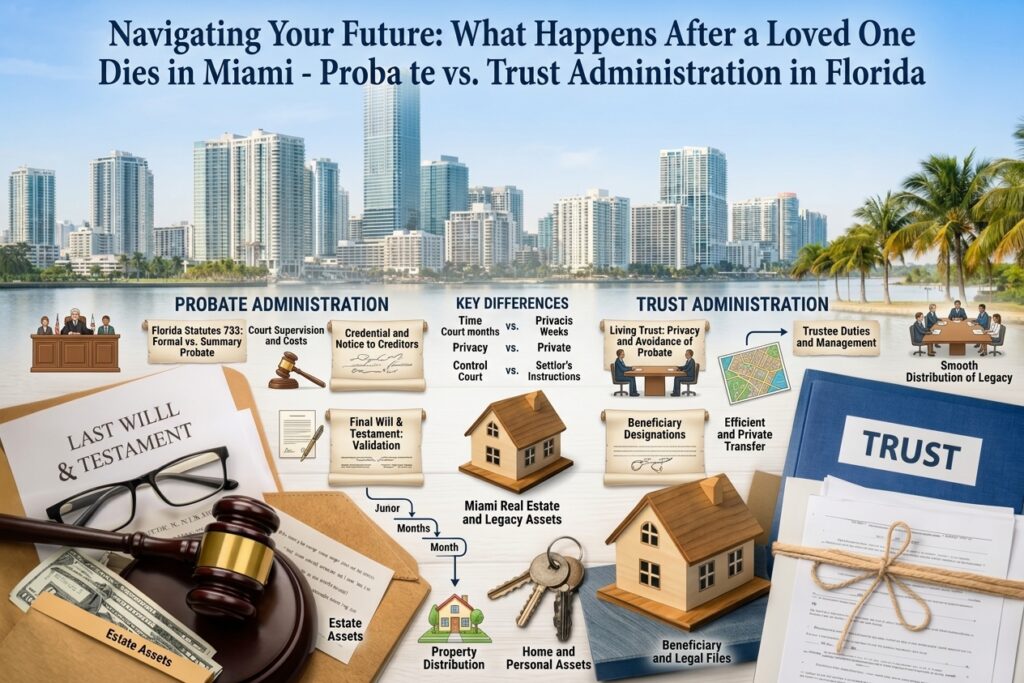
When someone you love dies, one of the first questions the family faces is whether the estate has to go through probate court or whether a trust can handle everything privately. The answer depends on how each asset was owned on the date of death, not on what the family assumes or what the will says.
This guide explains the difference between probate and trust administration in Florida, how to tell which one applies, what the personal representative or successor trustee must do, the Florida deadlines trustees often miss, and what each process costs and how long it takes in Miami-Dade County.
Quick answer: Probate is the court-supervised process for assets that were in the deceased person’s name alone with no beneficiary or co-owner. Trust administration is the private process a successor trustee uses for assets that were held in a funded living trust. Trust administration is usually faster and less expensive, but it is not completely court-free in Florida. The trustee must file a Notice of Trust with the court, notify beneficiaries within 60 days, and pay valid debts. Many families end up needing both, because assets left outside the trust still go through probate.
Does the Estate Need Probate or Trust Administration?
Look at how each asset was titled on the date of death. The same estate can have assets in all three categories.
| How the Asset Was Held | Examples | Process |
|---|---|---|
| In the deceased person’s name alone, no beneficiary | Bank account, car, house with no Lady Bird deed, brokerage account | Probate |
| Titled in the name of a living trust | House deeded to the trust, accounts retitled to the trust | Trust administration |
| Passes by beneficiary designation | Life insurance, IRA, 401(k), POD and TOD accounts | Neither. Paid directly to the beneficiary |
| Jointly owned with right of survivorship | Joint bank account, home owned as tenants by the entirety | Neither. Passes to the surviving owner |
| Home with a Lady Bird deed | Enhanced life estate deed recorded before death | Neither. Passes to the named remainder beneficiaries |
If the deceased person had a trust but some assets were never moved into it, those assets usually pass through probate under a pour-over will and then into the trust. This is the most common reason families with a trust still end up in probate court.
What Is Probate in Florida?
Probate is the court process for collecting a deceased person’s assets, paying valid debts and taxes, and transferring what is left to the beneficiaries named in the will, or to heirs under Florida intestate succession if there is no will. A judge appoints a personal representative and oversees the process. Florida has two main types.
Formal Administration
Formal administration is the full probate process. The court issues Letters of Administration to the personal representative, a notice to creditors is published, and the estate stays open until debts are resolved and assets are distributed. It is used for larger estates and any estate where creditors may have claims.
Summary Administration
Summary administration is a shorter process with no personal representative. It is available when the probate estate, not counting exempt property and protected homestead, is worth $75,000 or less, or when the person died more than two years ago.
What a Personal Representative Does
- Files the will and petition with the probate court
- Collects and safeguards the probate assets
- Publishes a notice to creditors and serves known creditors
- Files an inventory with the court
- Pays valid debts, expenses, and taxes
- Distributes the remaining assets and asks the court for discharge
What Is Trust Administration in Florida?
Trust administration is the process of settling a revocable living trust after the person who created it dies. The successor trustee named in the trust takes control of trust assets and follows the trust’s instructions without asking a judge for permission at each step. There are no court hearings in a routine case, and the trust terms stay private.
Successor Trustee Duties in Florida
- Accept the role and secure the assets. Gather the trust document, death certificates, and records for every trust account and property.
- File a Notice of Trust. Florida Statute 736.05055 requires the trustee to file a Notice of Trust with the court in the county where the person lived. In Miami-Dade, that is the Probate Division of the Eleventh Judicial Circuit.
- Notify qualified beneficiaries within 60 days. Florida Statute 736.0813 requires the trustee to tell qualified beneficiaries that the trust exists, who the trustee is, and that they have the right to a copy of the trust terms and to trust accountings.
- Get an EIN and open a trust account. After death, the trust becomes irrevocable and needs its own tax ID.
- Inventory and value the assets. Date-of-death values matter for taxes and for fair division among beneficiaries.
- Pay debts, expenses, and taxes. This includes the final income tax return and trust income tax returns.
- Account to beneficiaries. Keep records and provide trust accountings as Florida law requires.
- Distribute the assets. Transfer property and funds as the trust directs, often after a final accounting and signed receipts.
A successor trustee is a fiduciary. Mixing trust money with personal funds, favoring one beneficiary, or distributing too early can make the trustee personally liable.
Trust Administration Is Not Completely Court-Free in Florida
Many families are told that a trust means no court at all. In Florida that is not quite true.
- The Notice of Trust is filed with the court. It does not open a case or put the trust terms on record, but it is a required court filing.
- The trust can be responsible for the estate’s debts. If the probate estate is not enough to pay valid creditor claims and administration expenses, Florida law allows those to be paid from a revocable trust.
- Creditors get more time without probate. When a probate case publishes a notice to creditors, most claims must be filed within three months of first publication. With no probate case, creditors generally have up to two years from the date of death. That is why some trustees open a probate case even when most assets are in the trust, just to shorten the creditor window before distributing.
Probate vs. Trust Administration: Side-by-Side Comparison
| Probate | Trust Administration | |
|---|---|---|
| Who is in charge | Personal representative appointed by the court | Successor trustee named in the trust |
| Court supervision | Yes, from petition to discharge | No routine supervision. Notice of Trust filed with the court |
| Public record | Will, inventory, and filings are public | Trust terms stay private |
| Typical timeline | About 6 to 12 months, longer if contested | Often a few months, longer for complex trusts |
| Creditor deadline | Usually 3 months after notice is published | Up to 2 years after death unless probate is opened |
| Cost | Court costs, publication, and fees set against a statutory schedule | Usually lower. No court costs or hearings |
| Property in other states | May need a separate ancillary probate in that state | Trust-owned property avoids ancillary probate |
| Beneficiary rights | Enforced through the court case | Notice, copy of trust terms, and accountings under Florida trust law |
When You Need Both Probate and Trust Administration
An estate needs both processes when the person had a trust but did not move every probate asset into it before death. Common examples include a house that was never deeded to the trust, a bank account opened after the trust was signed, or an inheritance received late in life. The pour-over will sends those assets to the trust, but only after they pass through probate. If the leftover assets are small, summary administration may be enough.
The way to prevent this is to fund the trust fully during life. Our guide on how to avoid probate in Florida covers every option, and should you put your house in a trust in Florida explains the homeowner decision.
Step by Step: Probate in Miami-Dade County
- Deposit the original will with the Miami-Dade Clerk within 10 days of learning of the death.
- File a petition for administration in the Probate Division of the Eleventh Judicial Circuit.
- The court admits the will and appoints the personal representative.
- The personal representative receives Letters of Administration.
- Publish a notice to creditors and serve known creditors.
- File an inventory and collect the assets.
- Resolve creditor claims and pay expenses and taxes.
- Distribute assets, record deeds, and petition for discharge.
Step by Step: Trust Administration in Florida
- Locate the trust and confirm the successor trustee.
- File the Notice of Trust in the county where the person lived.
- Send the 60-day notice to qualified beneficiaries.
- Obtain an EIN and move funds into a trust account.
- Value assets, pay debts and expenses, and file tax returns.
- Provide an accounting, distribute assets, and close the trust.
How Long Does Each Process Take in Florida?
| Process | Typical Timeline | What Slows It Down |
|---|---|---|
| Summary administration | About 1 to 3 months | Missing documents, creditor objections |
| Formal administration | About 6 to 12 months | Will contests, real estate sales, tax issues |
| Simple trust administration | A few months | Waiting for tax filings and the creditor window |
| Complex trust administration | Up to 12 to 18 months | Business interests, ongoing trusts for children, disputes |
Cost of Probate vs. Trust Administration in Miami
Florida law sets a presumed reasonable attorney fee for formal probate based on the estate’s value. For estates over $100,000, it is $3,000 plus 3% of the value above $100,000, up to $1 million. The personal representative is also entitled to a fee, generally 3% of the first $1 million.
| Example: $800,000 Probate Estate | Amount |
|---|---|
| Presumed reasonable attorney fee | $24,000 |
| Personal representative fee | $24,000 |
| Potential combined fees, before court costs | $48,000 |
Family members serving as personal representative often waive their fee, and attorneys may agree to a different fee. Trust administration usually costs less because there are no court filings beyond the Notice of Trust, no hearings, and no publication. A family member serving as trustee may also waive trustee compensation.
Common Mistakes Families Make
- Assuming a trust means no lawyer. Trustees still have legal deadlines, tax filings, and fiduciary duties, and they can be personally liable for mistakes.
- Missing the 60-day beneficiary notice. Failing to give the required notice is a breach of trust in Florida.
- Distributing too early. Paying beneficiaries before debts, taxes, and the creditor window are handled can leave the trustee covering the shortfall.
- Ignoring unfunded assets. Anything left outside the trust may still need probate.
- Overlooking homestead rules. If the person left a spouse or minor child, Florida limits who can receive the home, even when it is held in a trust. These rules are explained in Florida homestead law and estate planning.
- Mixing funds. Paying trust bills from a personal account, or depositing trust money into one, creates accounting problems and liability.
Miami-Dade Probate Court: What Families Need to Know
Probate cases for Miami-Dade residents are filed with the Probate Division of the Eleventh Judicial Circuit, and the Notice of Trust is filed with the same court. Filings are made electronically through the Florida Courts E-Filing Portal. Florida requires a personal representative to have an attorney in most probate cases, and many Miami families prefer to work with a bilingual attorney who can explain each step in English or Spanish.
Frequently Asked Questions
-
What is the difference between probate and trust administration in Florida?
- Probate is a court-supervised process for assets in the deceased person’s name alone. Trust administration is a private process where a successor trustee settles assets held in a living trust. Probate is public and usually slower. Trust administration is private and usually faster.
-
Does an estate need probate if there is a trust?
- Only for assets that were not in the trust and had no beneficiary or co-owner. If the trust was fully funded, probate is usually not needed.
-
Is trust administration court-free in Florida?
Mostly, but not completely. The trustee must file a Notice of Trust with the court in the county where the person lived, even though no case is opened and the trust terms stay private.
-
What is a Notice of Trust in Florida?
- It is a short filing required by Florida Statute 736.05055. It lists the person’s name and date of death, the trust’s name and date, and the trustee’s name and address.
-
How long does trust administration take in Florida?
- A simple trust can often be settled in a few months. Trusts with real estate, business interests, tax issues, or disputes can take a year or more.
-
How long does probate take in Miami-Dade County?
- Formal administration usually takes about 6 to 12 months. Summary administration can take 1 to 3 months. Contested cases take longer.
-
Do you need a lawyer for trust administration in Florida?
- It is not required, but it is strongly recommended. Trustees must meet notice deadlines, file tax returns, and follow fiduciary rules, and they are personally liable for mistakes.
-
Can a trustee distribute assets right away?
- A trustee can, but it is risky. Creditors can have up to two years to bring claims against a revocable trust if no probate case is opened, so most trustees wait until debts and taxes are settled.
-
Can creditors collect from a living trust in Florida?
- Yes. If the probate estate cannot cover valid debts and expenses, Florida law allows them to be paid from the deceased person’s revocable trust.
-
How much does probate cost in Miami?
- For formal administration, Florida’s presumed reasonable attorney fee is $3,000 plus 3% of the estate value above $100,000, up to $1 million, plus court costs. A personal representative fee may also apply.
Work With a Miami Probate and Trust Administration Attorney
Whether the estate needs probate, trust administration, or both, the first steps set the timeline for everything that follows. Getting the notices, creditor deadlines, and asset transfers right protects the family and the person serving as personal representative or trustee. If you are still planning your own estate, our guides on the disadvantages of a living trust in Florida and Lady Bird deed vs. living trust in Florida can help you decide which plan fits your family.
Attorney Yanitza Schoonover handles formal administration, summary administration, and trust administration for families across Miami-Dade, Broward, and Palm Beach counties, in English and Spanish. She can review the assets, tell you which process applies, and guide the personal representative or successor trustee through every deadline.
Call (305) 299-7496 or email info@estateplanningattorney.us to schedule a free initial consultation. Phone and Zoom appointments are available Monday through Sunday, 8:00 AM to 9:00 PM.