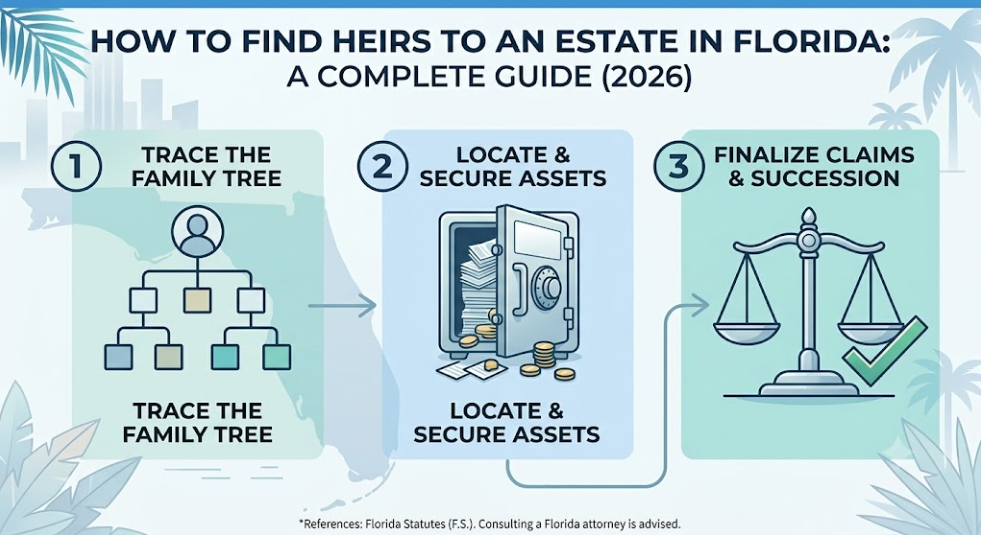
When someone dies in Florida, one of the first jobs of the personal representative is figuring out who is legally entitled to the estate. That sounds straightforward until the family tree has gaps: a sibling who moved abroad decades ago, children from a prior relationship nobody mentioned, half-siblings whose existence only came to light after the funeral, or a relative who simply vanished from contact years before.
This guide explains how heirs are legally determined in Florida, what a personal representative must do to find them, what happens when a search fails, and what to do if you believe you are a missing heir who was never notified of a Florida estate.
Key Takeaways
|
Heirs vs. Beneficiaries: The Distinction That Changes Everything
These two words are often used interchangeably, but they mean different things under Florida law and the difference determines which legal rules apply.
Heirs are people who inherit by operation of Florida law.
When a person dies without a valid will, Florida’s intestate succession statutes automatically determine who receives the estate. Those people are the heirs. They inherit not because they were named anywhere, but because Florida law says they are next in line. The personal representative of the estate has a legal obligation to locate them all.
Beneficiaries are people specifically named in a will or trust.
When a person dies with a valid will, the people named in that will as recipients are the beneficiaries. When a person has a funded revocable living trust, the people named in the trust are the beneficiaries. A beneficiary’s rights come from the document itself, not from Florida’s default succession rules.
A person can be both an heir and a beneficiary, or one without the other. The practical consequence: if a will exists and is valid, Florida’s intestate succession order generally does not control distribution. If no valid will exists, the intestate rules apply and the personal representative must identify and locate every legal heir.
Source: Florida Statutes Chapter 731 (Florida Probate Code definitions) | Florida Statutes Chapter 732 (Intestate Succession and Wills)
Who Inherits When There Is No Will? Florida’s Intestate Succession Order
When a Florida resident dies without a valid will, Florida Statutes Sections 732.101 through 732.111 determine who inherits. The order is fixed by law and does not consider family relationships or wishes that were never formally documented.
Florida’s intestate succession order, from first to last priority:
- Surviving spouse, subject to the rules in F.S. 732.102 governing what share the spouse receives depending on whether the deceased had living descendants from a prior relationship.
- Lineal descendants: children, grandchildren, and further generations. If a child predeceased the decedent but left their own children, those grandchildren step into the child’s share.
- Parents of the decedent, if no surviving spouse or descendants exist.
- Siblings and their descendants, if no surviving parents exist.
- More remote collateral relatives, half-blood relatives taking half a share, and ultimately the State of Florida if no relatives can be identified at all, a process called escheat under F.S. 732.107.
A situation that regularly surprises Florida families: when the deceased had children from a prior relationship, the surviving spouse does not inherit everything. Under F.S. 732.102, the surviving spouse receives half the estate and the descendants from the prior relationship receive the other half. This is one of the most common sources of unexpected conflict in Miami-Dade probate proceedings.
Source: Florida Statutes Sections 732.101 through 732.111 (Intestate Succession) | F.S. 732.102 (Spouse’s share of intestate estate)
How to Find Heirs to an Estate: The Diligent Search Standard
Under Florida Statutes Section 733.2121, the personal representative of a Florida estate has a legal obligation to conduct a diligent search for all known or reasonably ascertainable heirs and interested persons, and to serve them with formal notice of the probate proceeding.
The standard is not a quick internet search. Florida courts expect documented, reasonable efforts that are proportionate to the size of the estate and the degree of the relationship. A missing sibling who is believed to be alive requires more effort than a distant cousin whose existence is only theoretical.
What a diligent search for Florida heirs typically involves:
- Reviewing the decedent’s personal records, including address books, correspondence, email accounts, phone contacts, bank statements, tax returns, and social security records.
- Contacting known family members and associates and asking specifically about relatives who may have lost contact.
- Searching public records, including the Florida Department of State Division of Corporations, Miami-Dade County property records, the Florida voter registration database, and court records through the Miami-Dade Clerk of Courts.
- Using genealogy databases and social media, including Ancestry.com, FamilySearch (a free genealogical database), and LinkedIn or Facebook for recent contact information.
- Hiring a private investigator or professional heir search firm when initial efforts fail or when the estate is large enough to justify the cost.
Every step of the search must be documented in writing. Returned mail, unanswered calls, and notes from conversations with relatives all become part of the record. If the court later questions whether the search was adequate, documentation is the personal representative’s only protection.
Source: Florida Statutes Section 733.2121 (Notice to Creditors and Interested Persons) | Florida Probate Rule 5.040 (Notice)
What If an Heir Cannot Be Located in Florida Probate?
When a diligent search fails, the personal representative does not simply skip the missing heir and distribute the estate to everyone else. Florida law has a specific process for this situation.
Step 1: Service by publication.
Under Florida Probate Rules 5.040 and 5.041, the court may authorize service by publication when personal service cannot be accomplished after a diligent search. A legal notice is published in a newspaper in the county where the probate case is pending, once a week for two consecutive weeks. This satisfies the notice requirement for the missing heir even though they may not actually see it.
Step 2: Appointment of an attorney ad litem or guardian ad litem.
Under Florida Statutes Section 733.209, if a missing heir has a significant interest in the estate, the court may appoint an attorney ad litem to represent their interests. An attorney ad litem is different from a guardian ad litem: an attorney ad litem is appointed to advocate for an absent or unknown heir, while a guardian ad litem is appointed when a known heir is a minor or incapacitated. Either appointment allows the estate to proceed while protecting the absent person’s rights.
Step 3: Deposit of the missing heir’s share as unclaimed property.
Under Florida Statutes Section 733.816, if the estate is ready for distribution but a beneficiary’s whereabouts remain unknown, the personal representative may petition the court to deposit the missing heir’s share with the Chief Financial Officer. Those funds then enter Florida’s unclaimed property system under Chapter 717, where they are held indefinitely until the heir or their own heirs come forward to claim them.
Sources: Florida Statutes Section 733.209 (Attorney ad litem) | Florida Statutes Section 733.816 (Unclaimed devises) | Florida Statutes Chapter 717 (Florida Disposition of Unclaimed Property Act) | Florida Probate Rules 5.040 and 5.041
Heir Search Services: Percentage-Based vs. Flat-Fee Firms
When a personal representative exhausts their own search efforts, professional heir search firms are available. These firms use genealogical research, public records databases, and investigative tools to locate missing heirs and document the family tree. Two types exist, and the difference matters.
Percentage-based firms
charge a percentage of the heir’s share of the estate as their fee. This percentage is typically 10% to 40% and is deducted from the heir’s inheritance. The advantage is no upfront cost. The disadvantage is that the firm’s fee comes directly out of what the heir receives, which raises a disclosure and consent issue. Florida personal representatives engaging percentage-based firms should do so with court approval and full disclosure to the heir once located, since the heir’s consent to the fee arrangement is generally required.
Flat-fee or hourly firms
charge a set fee or an hourly rate regardless of what the estate is worth. The advantage is that the heir receives their full share without deduction. The disadvantage is that the cost comes from the estate itself and must be justified as a reasonable estate administration expense. AncestryProGenealogists and similar professional genealogy firms operate on this model.
Florida personal representatives choosing a search firm should seek attorney guidance before engaging either type. The personal representative has a fiduciary duty to the estate and to all interested persons, and an engagement that is later challenged as unreasonable or undisclosed can result in personal liability.
Source: HeirSearch.com industry analysis | Florida Statutes Section 733.601 (Fiduciary duties of personal representative)
What If You Think You Are a Missing Heir?
This angle is almost entirely absent from every competing page on this topic, but it represents a significant portion of the people searching for it. If you have reason to believe you are an heir to a Florida estate and you have not been contacted, here is what to do.
First, search Florida’s unclaimed property database.
Go to FLTreasureHunt.gov, the official Florida Department of Financial Services unclaimed property search. If a personal representative deposited your share under F.S. 733.816 because they could not locate you, your name may already be in the system. Search your full name and any previous names. This search is free.
Second, search the Miami-Dade County Probate Court records.
Probate proceedings in Florida are public record. If you suspect a relative died and left an estate in Miami-Dade County, you can search the Miami-Dade Clerk of Courts online portal for open or closed probate cases. If a case is open and you were not notified, a probate attorney can assess whether proper notice was given and whether you have a claim.
Third, consult a Florida probate attorney.
If you identify an open estate where you may have been entitled to notice, time matters. A personal representative who failed to give proper notice to a known or reasonably ascertainable heir can be held personally liable for the failure. An attorney can evaluate the facts, the diligence of the search that was conducted, and what remedies are available.
Source: Florida Department of Financial Services — FLTreasureHunt.gov | Miami-Dade Clerk of Courts online portal | F.S. 733.503 (Personal representative liability for improper distribution)
How Advance Estate Planning Eliminates Most Heir-Location Problems
The entire heir-location process exists because assets are passing through Florida probate court. A properly structured estate plan removes most assets from the probate estate entirely, which means no probate proceeding, no heir-location obligation, and no 9 to 24-month delay for a family that is already grieving.
Three planning tools that eliminate heir-location requirements:
- A funded revocable living trust transfers assets directly to named beneficiaries through the successor trustee at death, without any probate proceeding. No court involvement means no obligation to locate and notify heirs.
- A Lady Bird Deed on the family home transfers Florida real property to named beneficiaries at death without probate. The Miami-Dade County Clerk receives the death certificate and the property transfers automatically.
- Updated beneficiary designations on financial accounts, retirement accounts, and life insurance policies transfer those assets directly at death without any probate proceeding or heir-location requirement.
When an estate plan is in place and assets are properly titled, the question of who are the legal heirs of a deceased person becomes largely irrelevant from an administration standpoint. The named beneficiaries receive what the documents say they receive, promptly and without court involvement.
References and Legal Sources
- Florida Statutes Sections 732.101 through 732.111: Florida Intestate Succession
- Florida Statutes Section 732.102: Spouse’s share of intestate estate
- Florida Statutes Section 732.107: Escheat to state
- Florida Statutes Section 733.2121: Notice to creditors and interested persons (diligent search requirement)
- Florida Statutes Section 733.209: Appointment of attorney ad litem for missing heirs
- Florida Statutes Section 733.601: Fiduciary duties of personal representative
- Florida Statutes Section 733.816: Unclaimed devises (deposit of missing heir’s share)
- Florida Statutes Section 733.503: Personal representative liability for improper distribution
- Florida Statutes Chapter 717: Florida Disposition of Unclaimed Property Act
- Florida Probate Rule 5.040: Notice
- Florida Probate Rule 5.041: Service of pleadings and documents
- Florida Department of Financial Services: FLTreasureHunt.gov (official unclaimed property search)
- Miami-Dade Clerk of Courts: online probate case search portal