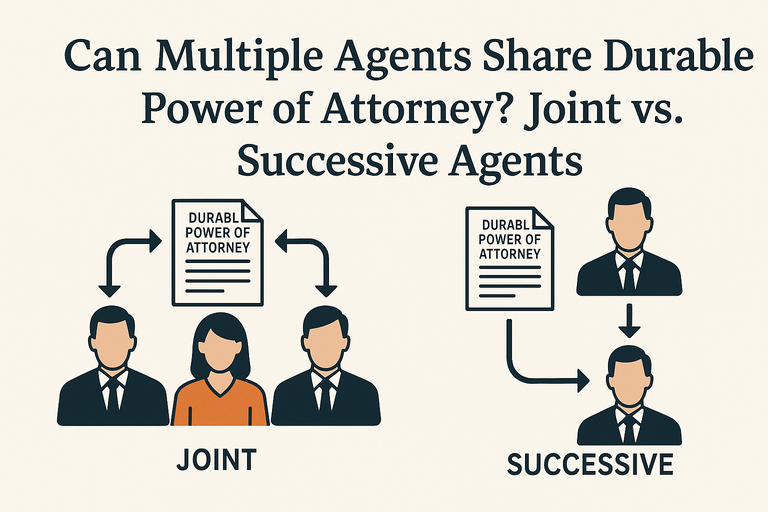
When you create a Durable Power of Attorney (DPOA), you’re giving someone legal authority to act on your behalf, often for financial or legal matters. But what if you don’t want just one person in charge? Maybe you have two adult children, or you want a backup if your primary agent can’t serve. Can multiple people share that role? The answer is yes, but it’s not as simple as it sounds.
Florida law does allow more than one agent to serve under a durable power of attorney. However, the way you set it up, whether they act jointly or successively can make a huge difference in how smoothly things work (or fall apart).
Who Are the “Principal” and the “Agent” (Attorney-in-Fact)?
Before getting into joint versus successive agents, it helps to know the basic terms. You, the person creating the power of attorney, are legally called the principal. The people you name to act for you are agents, though older documents sometimes use the term attorney-in-fact to mean the exact same thing. Whatever it’s called, the role is the same: managing your financial decisions, bank accounts, or real estate exactly as you’ve authorized.
What “Multiple Agents” Really Means
When you name more than one person in your DPOA, you can choose for them to act:
- Jointly: They must act together on all decisions.
- Independently (Co-agents): Each can act separately without the other’s approval.
- Successively: One serves first, and if that person can’t or won’t serve, the next one takes over.
These distinctions sound small but can completely change how effective your DPOA is.
Joint Agents: Shared Power, Shared Problems
With joint agents, all named individuals must agree and sign off on every action. That might sound fair after all, two heads are better than one, but it can turn simple tasks into bureaucratic nightmares.
Example:
Imagine two siblings, Carlos and Maria, named as joint agents for their father’s DPOA in Miami. Their dad needs to sell a condo to pay medical bills. Carlos agrees; Maria hesitates. Because both must sign, the sale stalls for months, and the financial strain worsens.
Under Florida Statute §709.2111, when agents are required to act jointly, any disagreement can halt action entirely. Financial institutions may also refuse to honor partial signatures, causing delays even in routine matters like paying bills or managing accounts.
Pros:
- Built-in checks and balances
- Prevents one agent from abusing power
Cons:
- Requires constant coordination
- Can lead to deadlock
- Causes delays in time-sensitive matters
Co-Agents Acting Independently
A co-agent arrangement gives each agent the ability to act on their own. That means either person can make decisions, sign checks, or manage property without the other’s involvement.
This setup is much faster and more flexible, but it comes with risk. If two agents act independently, their decisions must not conflict. One might sell a car while the other tries to donate it. Legally, both actions could be binding, creating a mess for banks, title companies, or family members.
Florida law allows co-agents to act independently unless the DPOA specifically requires joint action. (See Florida Statute §709.2111(1)). But if co-agents disagree and the dispute affects the principal’s interests, the issue may need to be resolved in court which defeats the purpose of having a DPOA for efficiency.
Real-world scenario:
If your mom names both you and your brother as co-agents, and you use her funds to remodel her home while your brother withdraws money to invest elsewhere, both transactions are legal but together, they could drain her savings fast.
What Does “Joint and Several” Power of Attorney Mean?
You may come across the phrase “jointly and severally” while researching this. It isn’t a fourth structure, it’s just another way of describing the co-agent arrangement above. “Severally” means each agent can act completely on their own; “jointly” means both remain responsible for how that authority gets used. If your document names agents to act “jointly and severally,” it works exactly like naming co-agents: either person can act alone, and both are accountable for the outcome.
Successive Agents: A Safer, Simpler Alternative
For most people, the successive (or successor) agent setup is more practical. You choose one primary agent who acts first and name backups in case that person becomes unable or unwilling to serve.
This avoids conflict entirely, only one person has authority at a time. When the first agent can’t serve (due to death, incapacity, or resignation), the next one steps in automatically.
Example:
Your daughter is the primary agent. If she moves overseas or can’t continue, your son becomes the acting agent without needing court approval.
Benefits:
- Eliminates confusion and overlap
- Reduces family tension
- Keeps authority clear and traceable
The key is to specify the order of succession clearly in the document so financial institutions know exactly who’s in charge and when.
Every Agent Owes You a Fiduciary Duty, No Matter the Structure
Whether you choose joint agents, co-agents, or a successive chain, everyone you name owes you the same legal obligation: a fiduciary duty to act only in your interest, never their own. Structure doesn’t change this, a co-agent acting alone has exactly the same duty as a joint agent who needs someone else’s sign-off. If an agent breaches that duty, the arrangement you chose won’t shield them from liability. See our guide on warning signs of power of attorney abuse for what a breach looks like and what you can do about it.
Florida Execution Requirements for a Multi-Agent DPOA
Naming more than one agent doesn’t change how the document itself has to be signed. Under Florida law, a durable power of attorney must be signed by the principal, signed in the presence of two witnesses, and notarized, whether you’re naming one agent or several. See our full Florida power of attorney page for complete requirements.
Common Mistakes to Avoid
- Leaving decision-making rules vague.
If your DPOA doesn’t say whether agents act jointly or independently, Florida law assumes they can act independently, which may not be what you want. - Choosing agents who don’t get along.
No legal wording can fix personal conflict. If your co-agents don’t communicate well, joint authority will only amplify friction. - Failing to notify institutions.
Always provide updated, notarized copies to banks, title companies, and financial advisors. They’ll want clarity on who has power at any given time. - Not updating after life changes.
Divorce, relocation, or death of an agent should trigger a review and revision of your DPOA.
When to Get Professional Help
If you live in Florida, working with an estate planning attorney is essential to ensure your DPOA meets state-specific requirements, such as signing in the presence of two witnesses and a notary. An attorney can also draft custom language to:
- Require joint consent for major decisions (like selling property)
- Allow independent action for routine matters (like paying bills)
- Set up clear successor chains to avoid power gaps
Takeaways
- You can appoint multiple agents under a durable power of attorney in Florida, but structure matters.
- Joint agents must agree on everything: safer, but slower.
- Co-agents can act independently: faster, but riskier.
- Successive agents offer the cleanest, most conflict-free approach for most families.
- Always get legal guidance before finalizing your DPOA, mistakes here can cause chaos when you’re least able to fix them.
Frequently Asked Questions
Can two people have power of attorney in Florida?
Yes. You can name more than one agent and structure their authority to act jointly, independently as co-agents, or successively.
Can more than one person have power of attorney at the same time?
Yes, as joint agents or co-agents. If you’d rather only one person hold authority at any given time, a successive agent structure fits better.
What does “power of attorney jointly and severally” mean?
It generally means each agent can act alone while both remain jointly responsible for the outcome, functionally the same as a co-agent arrangement.
What’s the difference between a successor agent and an alternate agent?
The terms are generally used interchangeably, both describe a backup agent who steps in if the primary agent can’t or won’t serve.
Do co-agents have to agree on every decision?
No. Unless the document specifically requires joint action, Florida law lets co-agents act independently of each other.
Get Help Setting Up a Multi-Agent Power of Attorney
Choosing the right structure now joint, co-agent, or successive, heads off exactly the kind of family conflict and delay described above. Attorney Yanitza Schoonover can help you decide what fits your family and draft the language to make it work. Call (305) 299-7496 or schedule a free consultation.