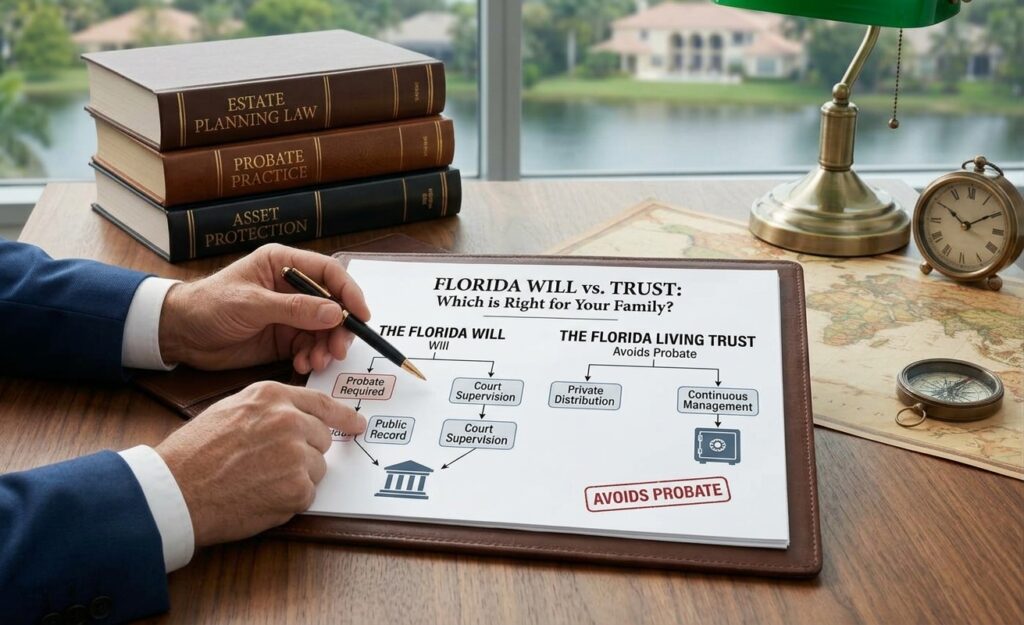
Ask ten people whether they need a will or a trust and you will likely hear ten different answers. Both documents say who receives your property when you die, so it is easy to assume they are interchangeable. They are not. In Florida, the choice between a will and a trust decides whether your family goes to probate court, how long they wait for their inheritance, how much of your estate goes to fees, and who can step in if you become too sick to manage your own affairs.
This guide walks through the will vs trust question in plain language: what each document does, the key differences under Florida law, what each one costs, the real advantages and disadvantages of a living trust, and how to decide which one fits your family.
Quick answer: A will is simpler and less expensive to create, but it does not avoid probate in Florida. A funded revocable living trust costs more up front, but it keeps your assets out of probate, stays private, and lets a trusted person manage your property if you become incapacitated. Many Florida families use both: a trust to hold their main assets and a short “pour-over” will to catch anything left outside the trust and to name a guardian for minor children.
What Is a Will in Florida?
A last will and testament is a written document that tells the court who should receive your property after you die, who should manage your estate (called the personal representative in Florida), and who should raise your minor children. Under Florida law, a will must be signed by you in front of two witnesses, who also sign. Adding a notary makes the will “self-proving,” which means the witnesses do not have to be tracked down later to confirm it. The steps for doing this correctly are covered in the guide on how to make a legal will in Florida.
A will only takes effect at death. It does nothing while you are alive, and it has no power if you become incapacitated. It is also a set of instructions to the probate court, not a way around it.
What Is a Revocable Living Trust in Florida?
A Florida revocable living trust is a legal arrangement you create during your lifetime to hold your assets. You transfer your home, bank accounts, and investments into the trust, and you usually serve as your own trustee, so day to day nothing changes. You can buy, sell, spend, and change the trust whenever you want.
You also name a successor trustee. If you become incapacitated, that person steps in to manage the trust for your benefit. When you die, the successor trustee pays your final bills and distributes the trust assets to your beneficiaries privately, without probate. For a deeper look at the mechanics, the article on how a revocable living trust works in Florida explains each stage, and the comparison of revocable vs. irrevocable trusts explains why most families start with the revocable kind.
The Difference Between a Will and Trust in Florida
The biggest difference between a will and trust comes down to timing and court involvement. A will speaks only after death and works through the probate court. A trust works during your life and after death, and it operates privately.
| Feature | Will | Revocable Living Trust |
|---|---|---|
| When it takes effect | Only at death | As soon as it is signed and funded |
| Avoids probate? | No | Yes, for assets held in the trust |
| Public or private? | Becomes public record in probate | Stays private |
| Helps if you become incapacitated? | No | Yes, your successor trustee steps in |
| Names a guardian for minor children? | Yes | No (a will is still needed for this) |
| Time for heirs to receive assets | Usually 6 to 18 months or longer | Often weeks to a few months |
| Up front cost | Lower | Higher |
| Cost after death | Higher (probate fees and court costs) | Lower (no probate) |
| Ongoing work | Update after life changes | Keep new assets titled in the trust |
Does a Will Avoid Probate in Florida?
No. This is the most common misunderstanding about wills. A will does not avoid probate in Florida; it is the document the probate court uses. After death, the original will must be filed with the clerk of court, and any assets in your name alone must pass through probate before they reach your beneficiaries.
Florida formal probate typically takes 6 to 18 months, and longer if there is real estate to sell, a creditor dispute, or a family disagreement. The details of that timeline are covered in the article on how long probate takes in Miami. Probate also costs money. Florida’s fee guideline for personal representative attorneys is roughly 3% of the estate’s value, so a $400,000 estate can easily see $12,000 or more in attorney fees alone, plus court costs.
A will can still be part of a plan that avoids probate. Accounts with a payable on death or transfer on death beneficiary pass outside probate no matter what the will says, as explained in the guide on POD vs TOD accounts in Florida. And a Florida home can pass outside probate with a Lady Bird deed. But the will itself never keeps anything out of court.
Does a Trust Avoid Probate in Florida?
Yes, but only for assets that are actually in the trust. This is where many trust plans fail. Signing the trust document is only half the job. You must also retitle your home, bank accounts, and investment accounts into the name of the trust, or name the trust as beneficiary. An asset left in your personal name at death still goes through probate, even if your trust says it should go to your children.
That process is called funding, and it is the most important step after signing. The checklist in how to fund a revocable living trust in Florida walks through each type of asset. When a trust is properly funded, your successor trustee can begin managing and distributing assets right after your death, with no court case. The steps your trustee follows are explained in what happens to a trust when you die in Florida.
Benefits of a Revocable Living Trust
For many Florida families, the benefits of a revocable living trust outweigh the higher up front cost. Here is what a trust offers that a will cannot.
Your Family Avoids Probate
A funded trust skips the probate process entirely. There is no court filing to open an estate, no waiting for a judge to appoint a personal representative, and no statutory probate fees. The guide on probate vs. trust administration shows side by side how much faster and simpler trust administration usually is.
Privacy for Your Family
A will filed in probate becomes a public record. Anyone can look up who inherited what. A trust stays private between the trustee and the beneficiaries.
Protection If You Become Incapacitated
If you suffer a stroke, develop dementia, or are seriously injured, your successor trustee can manage everything in the trust immediately. Without a trust or a durable power of attorney, your family may need a court guardianship, which is slow, expensive, and supervised by a judge. Choosing that person carefully matters, and the guide on how to choose a successor trustee in Florida covers what to look for.
More Control Over How Heirs Receive Money
A will generally hands assets over outright. A trust can hold money for a young adult until a certain age, release it in stages, protect a beneficiary who struggles with debt or addiction, or provide for a spouse while preserving the remainder for children from an earlier marriage. That last point is especially important in estate planning for blended families in Florida.
One Plan for Property in Several States
If you own a condo in Florida and a cabin in North Carolina, a will means two probate cases, one in each state. A trust that holds both properties avoids both.
Disadvantages of a Living Trust
A trust is not the right answer for everyone. These are the honest drawbacks to weigh.
- Higher up front cost. A trust based plan costs more to prepare than a simple will package.
- Funding takes effort. You must retitle accounts and record a new deed for your home. Skipping this step leaves assets exposed to probate.
- It must be kept up to date. New accounts or property bought later need to be titled in the trust, too.
- No lawsuit or creditor protection while you are alive. Because you control a revocable trust, your creditors can still reach its assets, and after your death, Florida law allows trust assets to be used for valid estate debts if the probate estate cannot cover them.
- No income tax or estate tax savings by itself. A revocable trust is ignored for income tax purposes while you are alive and does not, on its own, reduce estate taxes.
- It does not name a guardian for children. You still need a will for that.
None of these drawbacks is a reason to skip planning. They are reasons to plan carefully with someone who will make sure the trust is funded and coordinated with the rest of your documents.
How Much Does a Will Cost in Florida?
A simple will prepared by a Florida estate planning attorney usually costs between a few hundred dollars and about $1,500, depending on the attorney and what is included. At The Schoonover Law Firm, a basic will package typically runs $800 to $1,500 and includes the will, a durable power of attorney, a healthcare surrogate designation, and a living will.
Keep in mind that the true cost of a will often shows up later. If your estate must go through probate, attorney fees, court costs, and the time your family spends waiting can far exceed what a trust would have cost.
How Much Does a Trust Cost in Florida?
A complete trust based plan in Florida usually costs more than a will because it involves more documents and the work of funding the trust. At The Schoonover Law Firm, a full plan typically runs $3,500 to $8,000. That includes the revocable living trust, a pour-over will, a durable power of attorney, healthcare documents, and a deed to place your Florida home in the trust or protect it with a Lady Bird deed.
Every plan is quoted as a flat fee in writing before any work begins. The article on flat fee estate planning explains how that pricing works and why it protects you from surprise bills.
| Cost Comparison | Will Based Plan | Trust Based Plan |
|---|---|---|
| Up front attorney fee (our firm) | $800 to $1,500 | $3,500 to $8,000 |
| Probate attorney fees at death ($400,000 estate) | Roughly $12,000 or more | None for funded assets |
| Court costs and filing fees | Several hundred dollars or more | None for funded assets |
| Time before heirs receive assets | 6 to 18 months or longer | Often weeks to a few months |
Who Needs a Living Trust?
A trust is usually worth considering if any of the following describe your situation:
- You own a home or other real estate in Florida, especially if it is worth more than a modest amount.
- You own property in more than one state.
- You want to keep your estate private.
- You want someone you trust to manage your finances if you develop dementia or become seriously ill.
- You have minor children, young adult children, or a beneficiary who should not receive a lump sum.
- You are in a second marriage or have stepchildren.
- You have a family member who might challenge your plan.
When a Will May Be Enough
A will based plan can work well if you are young, rent your home, and have modest savings with beneficiaries named on your accounts. It can also be enough if your Florida home will pass by Lady Bird deed and your other assets have payable on death or transfer on death designations. The rules for those designations are explained in how beneficiary designations work in Florida. In that kind of plan, the will mainly names a guardian for your children and catches anything that slipped through.
Just remember to revisit the plan as your life changes. Buying a home, having a child, marrying, or divorcing are all moments to update or change your will and to ask whether it is time to add a trust.
Should I Have a Will or Trust? Why Many Florida Families Use Both
For most homeowners, the answer to “do I need a will or trust” is both. The trust holds your main assets and keeps them out of probate. A short pour-over will works as a safety net: it sends any asset you forgot to place in the trust into it, and it names a guardian for minor children. The article on do I need a will if I have a trust in Florida explains why that backup matters.
The right mix depends on your home, your family, and your goals. If your main concern is keeping things out of court, a funded trust is the strongest tool. If cost is the main concern and your assets are simple, a will combined with beneficiary designations and a Lady Bird deed can cover a lot of ground. Either way, the broader options are laid out in the guide on how to avoid probate in Florida.
Frequently Asked Questions
What is the difference between a will and trust in Florida?
Which is better, a will or trust?
Does a will avoid probate in Florida?
Does a trust avoid probate in Florida?
How much does a will cost in Florida?
How much does a trust cost in Florida?
How does a revocable living trust work?
What are the disadvantages of a living trust?
Do I still need a will if I have a trust?
Does a revocable trust protect my home from Medicaid in Florida?
Work With a Florida Estate Planning Attorney
Choosing between a will and a trust is easier when someone looks at your actual home, accounts, and family and tells you plainly what each option would mean for the people you love. If you are already handling a loved one’s estate, the guides on what happens after someone dies in Florida and probate vs. trust administration can help you understand which path that estate will follow.
Attorney Yanitza Schoonover prepares wills and trusts for Florida families and makes sure each trust is properly funded, so it actually keeps assets out of probate. She also uses Lady Bird deeds to protect Florida homes and plans ahead for the risk of Medicaid estate recovery, so the plan you sign today works the way you expect later.
Call (305) 299-7496 or email info@estateplanningattorney.us to schedule a free initial consultation. Phone and Zoom appointments are available Monday through Sunday, 8:00 AM to 9:00 PM.
The Schoonover Law Firm, P.A. | 6303 Waterford District Drive, Suite 400, Miami, FL 33126 | Florida Bar #124081