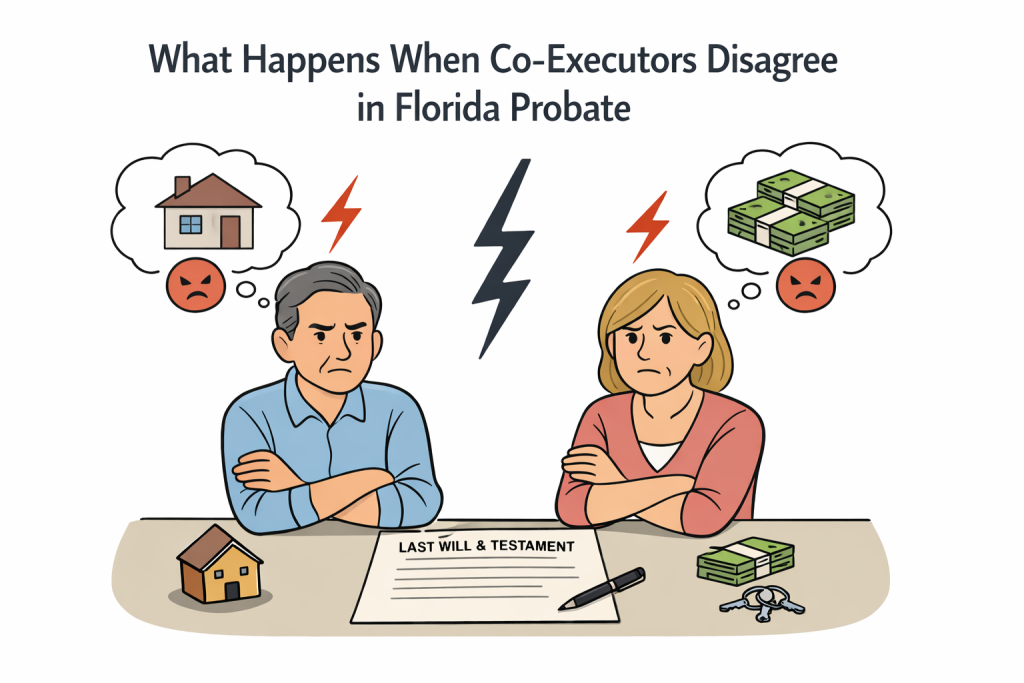
Naming co-executors is often meant to promote balance or family harmony. In Florida probate, it frequently does the opposite. When co-executors disagree, probate can slow, stall, or turn adversarial; and the court may be forced to intervene.
Florida law does not assume co-executors will resolve disputes privately. It provides specific rules and remedies when they don’t.
This article explains what happens when co-executors disagree in Florida probate, how authority is exercised, and how courts break deadlock.
What Are the Duties of a Co-Executor in Florida?
A co-executor, also called a co-personal representative, has a legal responsibility to manage the estate properly. This responsibility is known as a fiduciary duty, a legal obligation to act in the best interest of the estate and its beneficiaries, not for personal gain.
Co-executor duties include:
-
Locating and securing all estate assets
-
Paying the deceased’s debts and taxes
-
Managing and protecting estate property
-
Filing required court documents and accountings
-
Distributing assets to beneficiaries according to the will
When co-executors understand their duties clearly, it can prevent misunderstandings. But when a co-executor is not cooperating, fulfilling these duties becomes difficult or impossible, which is when the court may need to step in.
Co-Executors Must Act Together Unless the Will Says Otherwise
By default, Florida treats co-executors as joint fiduciaries.
That means:
- Major decisions require agreement
- One co-executor cannot act unilaterally
- Authority is shared, not divided
Unless the will grants independent authority, disagreement can freeze action entirely.
Common Issues Co-Executors Fight Over
Most disputes follow predictable patterns.
Frequent points of conflict include:
- Selling vs. keeping real estate
- Timing of distributions
- Choice of professionals (lawyers, accountants, realtors)
- Handling of rental property
- Paying certain creditors
- Responding to beneficiary pressure
- Strategy in contested matters
Disagreements often reflect different risk tolerance, not bad intent.
What Happens When Co-Executors Deadlock
When co-executors cannot agree:
- Probate actions may halt
- Deadlines may be missed
- Assets may lose value
- Court supervision increases
Florida probate courts do not tolerate prolonged paralysis. Deadlock is treated as a risk factor.
Can One Co-Executor Override the Other?
Usually, no.
Absent specific language in the will:
- One co-executor cannot sell property alone
- One cannot distribute assets alone
- One cannot bind the estate unilaterally
Any unilateral action risks invalidation and personal liability.
How Florida Courts Respond to Co-Executor Disputes
When disagreement reaches the court, judges have several options.
Court-Ordered Direction
The court may:
- Decide the disputed issue directly
- Order a specific action (e.g., sale of property)
- Set timelines for compliance
This removes discretion from both executors.
Imposition of Supervision or Reporting Requirements
Courts may require:
- Frequent status reports
- Accountings
- Prior approval for actions
- Increased oversight
Supervision slows probate but reduces risk.
Appointment of a Neutral Third Party
In some cases, courts may:
- Appoint a neutral personal representative
- Appoint a curator or special fiduciary
- Shift authority away from both co-executors
This is common when hostility is high.
Removal of One or Both Co-Executors
Removal is possible when disagreement causes:
- Missed deadlines
- Asset loss
- Fiduciary breaches
- Procedural noncompliance
Courts remove executors to protect the estate, not to resolve family drama.
Can a Co-Executor Resign in Florida?
Yes, a co-executor can resign in Florida. This is often the simplest solution when co-executors disagree so strongly that they cannot work together.
To resign, a co-executor must:
-
File a formal petition with the Florida probate court
-
Provide an accounting of their actions so far
-
Notify all other co-executors and beneficiaries
-
Get court approval for the resignation
The court will typically approve the resignation if it does not harm the estate. The remaining co-executor or a successor named in the will will then handle the estate administration alone. Resigning can be a responsible choice when a co-executor realizes they cannot serve effectively alongside the other.
Beneficiary Role in Co-Executor Disputes
Beneficiaries often escalate co-executor conflict.
They may:
- File motions to compel action
- Object to delays
- Seek removal
- Challenge fee requests
Beneficiary pressure frequently triggers court intervention even when executors are evenly matched.
Liability Risks When Co-Executors Disagree
Disagreement does not shield executors from liability.
Executors may still be exposed if:
- They fail to act at all
- They allow assets to deteriorate
- They miss deadlines
- They ignore court orders
“Blaming the other executor” is not a defense.
How Courts Decide Who Is at Fault
Florida judges evaluate:
- Which executor attempted to move the case forward
- Documentation of efforts
- Compliance with deadlines
- Reasonableness of positions taken
- Willingness to seek court guidance
The executor who documents diligence usually fares better.
How Co-Executors Can Resolve Disputes Without Court Action
The most effective strategies include:
- Deferring to the will’s priorities
- Seeking joint legal advice
- Using mediation early
- Asking the court for limited instruction
- Dividing responsibilities where permitted
Early intervention prevents escalation.
Why Co-Executor Deadlock Often Makes Probate Worse
Co-executor disputes:
- Increase costs
- Delay distributions
- Invite beneficiary litigation
- Trigger court supervision
- Reduce executor compensation
What starts as “shared responsibility” often becomes shared liability.
When Co-Executors Should Step Aside
If disagreement is persistent and personal:
- Resignation may be appropriate
- Neutral appointment may protect everyone
- Continuing despite conflict often harms the estate
Courts respect executors who recognize when they cannot serve effectively.
Bottom Line
Florida probate assumes executors will act, not argue. When co-executors disagree and probate stalls, courts intervene to protect the estate, not the relationship.
Co-executors who cannot collaborate should expect loss of control, increased scrutiny, and reduced compensation.
Frequently Asked Questions About Co-Executors in Florida
Q: Can one co-executor act alone?
A: Usually no. Unless the will specifically says otherwise, co-executors must agree on major decisions like selling property or making distributions.
Q: What happens if co-executors disagree?
A: The probate process can stall. The court may need to intervene by ordering a specific action, appointing a neutral party, or removing an uncooperative executor.
Q: Can a co-executor resign in Florida?
A: Yes. A co-executor can file a petition with the court to resign, but the court must approve it.
Q: What are the risks of being a co-executor?
A: Co-executors can be held personally liable if they fail to act or mismanage estate assets. Disagreement does not protect you from liability.
Q: Can a beneficiary remove a co-executor?
A: A beneficiary cannot remove an executor directly, but they can petition the court to do so if there is good cause, such as a breach of fiduciary duty or failure to act.
Schedule a Free Consultation
A co-executor conflict can turn a manageable probate into a costly, stressful nightmare. If you are struggling with an uncooperative co-executor, get legal advice as soon as possible.
Yanitza Schoonover is a Florida Bar licensed estate planning and probate attorney. She helps families and executors navigate complex probate disputes with clear, direct guidance.
Call (305) 299-7496 or schedule a free consultation today to discuss your co-executor problems.